
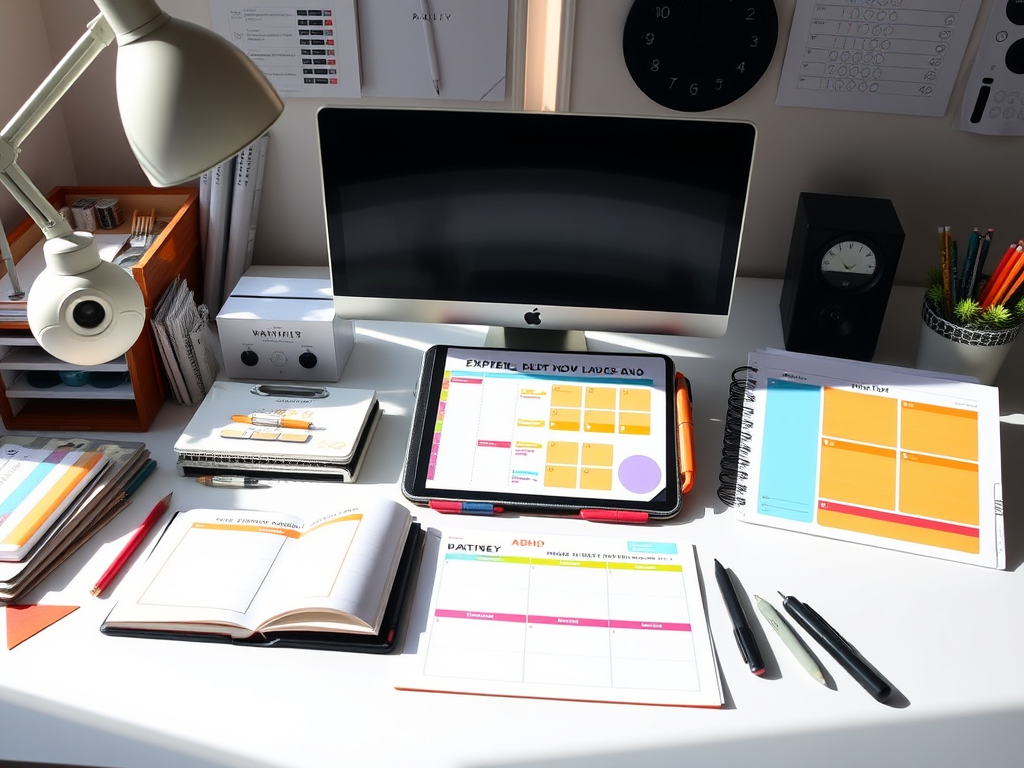
If you’ve ever bought a gorgeous planner only to abandon it after a week, you’re not alone—especially if you’re living with ADHD or other executive function challenges. You need ADHD planner templates! Traditional planners often assume that focus, motivation, and energy will be steady from day to day. But real life (and real brains) don’t necessarily work that way.
This guide offers two things: free ADHD planner templates you can download right now, and step-by-step guidance for creating a daily routine that sticks. These templates are designed for brains that thrive on flexibility and visual cues, helping you stay organized even when attention or energy dips. (Or, click here to learn about the best planner for adhd!)
Why Standard Planners Fail ADHD Brains
For many people with ADHD, a typical planner can feel more like a guilt trip than a helpful tool. Tiny boxes crammed with text and rigid hour-by-hour scheduling demand a level of predictability that’s tough to maintain. When a plan inevitably falls apart—because of time blindness, an unexpected distraction, or simply a low-energy day—the empty pages can become a source of stress and shame.
Executive function skills such as time management, task initiation, and working memory are the very abilities that standard planners rely on. When those skills are taxed, it’s easy to fall behind and abandon the planner altogether. The result? A cycle of buying new planners, trying again, and feeling defeated when the old patterns return.
That doesn’t mean planning is hopeless. It just means your planning tools need to match the way your brain works- and that often starts with adhd planner templates (like the downloadable pdf templates below).
What You find in ADHD Planner Templates
An ADHD-friendly daily planner doesn’t try to squeeze you into a rigid template—it adapts to your reality. Look for (or design) layouts that offer:
- Open, uncluttered space so your eyes can focus quickly without overwhelm.
- Color-coding or icons for instant recognition of priorities or categories.
- Built-in “brain dump” or emotional check-in areas to capture thoughts before they spiral.
- Flexible daily or weekly formats that let you skip a day without “ruining” the system.
- Visual cues for momentum such as Pomodoro or focus-block timers.
These features aren’t just aesthetic; they’re functional supports for executive function. By reducing the cognitive load of planning itself, they free up your mental energy for the tasks that really matter.
Free Printable ADHD Planner Templates You Can Download Today
Below you’ll find three free ADHD planner templates and ideas you can start using immediately. Each is designed to work on its own or alongside the others. Choose the one that matches your current needs—or mix and match to build a system that feels natural.
- Daily Focus Planner
What it’s for: Quick, one-day planning when you need clarity without getting lost in the week ahead.
How to use it:- Begin each morning with a brain dump—jot down everything on your mind.
- Pick your Top 3 Priorities and circle them.
- Use the open blocks to sketch a loose schedule or just time-block the moments when you’re most alert.
- Weekly Overview
What it’s for: Seeing the big picture of appointments, deadlines, and personal goals.
How to use it:- On Sunday (or whatever your “reset” day is), fill in fixed events first—work shifts, classes, or family activities.
- Add flexible goals in a separate column.
- Use color-coded dots or highlighters to mark which tasks require high energy and which are easy wins.

- Pomodoro / Focus Blocks
What it’s for: Structuring work into short, manageable sprints.
How to use it:- Decide on a single task and start a 25-minute timer.
- After each block, check off a “Pomodoro” box and record a short note on progress or distractions.
- After four blocks, reward yourself with a longer break.
Tip: Print several copies and keep them in a folder or binder. If you prefer digital tools, these layouts also work well on a tablet with a stylus.
How to Build a Routine That Sticks with ADHD Planner Templates
The ADHD daily planner or ADHD planner templates system is only half the story. The other half is creating habits that support your brain on good days and bad. Here’s a step-by-step routine you can adapt:
- Start with an energy check-in. Each morning, note how you’re feeling—physically and emotionally. This small pause helps you set realistic expectations for the day.
- Choose your “must-do” tasks. Limit it to one to three key items. Finishing these will make the day a success, even if everything else gets pushed.
- Time-block for focus. Use the Pomodoro template or simple 30-minute blocks. Schedule your highest-energy work for the hours you’re naturally most alert.
- Leave white space. Build in buffer time for unexpected distractions or a quick reset.
- Review at day’s end. Jot down what worked and what didn’t. This reflection turns each day into data you can use to fine-tune tomorrow.
Remember: the goal isn’t perfection. It’s creating a routine that bends with you rather than breaking when life gets messy.
Next-Level Tips for ADHD Time Management
- Pair paper with digital. Use phone alarms or smart-watch reminders to nudge you when it’s time to switch tasks or take a break.
- Make tasks visible. Post your Top 3 priorities on the fridge, a whiteboard, or even a sticky note on your laptop.
- Reward momentum, not perfection. Celebrate when you start—even if the finish line is still far away.
- Have a fallback plan. Keep a “bare-minimum list” for low-energy days: a handful of tasks that keep life moving when motivation is thin.
These techniques turn your planner from a static calendar into an active support system, one that works with the way ADHD brains actually operate.
Bringing It All Together
ADHD planner templates (or an ADHD daily planner) are more than a place to jot down tasks—they’re tools for self-support. By choosing layouts designed for flexibility and by creating routines that match your natural rhythms, you turn planning from a chore into a daily act of care. Remember, the goal isn’t to fill every square inch of a page; it’s to build a system that helps you start, stay on track, and recover quickly when life throws you off.
Small, consistent steps matter more than a perfectly executed plan. Even on low-energy days, a quick check-in or a single Pomodoro block is progress. Over time, those micro-wins build the kind of routine that sticks.
Download Your Free ADHD Daily Planner Templates
You can download the free ADHD planner templates here. Whether you prefer a daily focus sheet, a weekly overview, or Pomodoro-style focus blocks, each template is designed to help you work with your brain—not against it. Print a few copies or load them onto a tablet and start experimenting today.
Keep Exploring ADHD Planner templates and more

If you’re ready to dive deeper, explore these related resources:
- ThriveMind executive dysfunction planner – a comprehensive neurodivergent-friendly planner. (Learn about the kickstarter here)
- The Executive Function Toolkit – Executive function checklists and worksheets for time management, task initiation, and emotional regulation.
Final Encouragement
Planning with ADHD isn’t about becoming someone you’re not—it’s about meeting your mind where it is. With the right tools and a forgiving routine, you’ll discover that structure and spontaneity can coexist. Your adhd planner templates becomes partners in progress, helping you turn intention into action and action into habits that last.
More Executive Function Toolkit Resources:
→ Download Your Free ADHD Planner Templates and start creating a daily routine that actually works.
→ Learn more about the ThriveMind Neurodivergent Daily Planner
→ Learn about ADHD Daily Planner Layout A
Leave a Reply