
If you’ve accepted the role of executive function challenges in ADHD and other neurodevelopmental disorders, then you’ve come a long way from seeing missed deadlines and lost car keys as direct personal failures. Today, we know that these “careless” tendencies often stem from real, neurological differences—and are commonly tied to executive functioning.
And yet, many popular life coaching tools still fail to account for those differences. I spent quite a while rethinking the Wheel of Life while working on my ThriveMind Neurodivergent Planner, and arrived at some key insights.
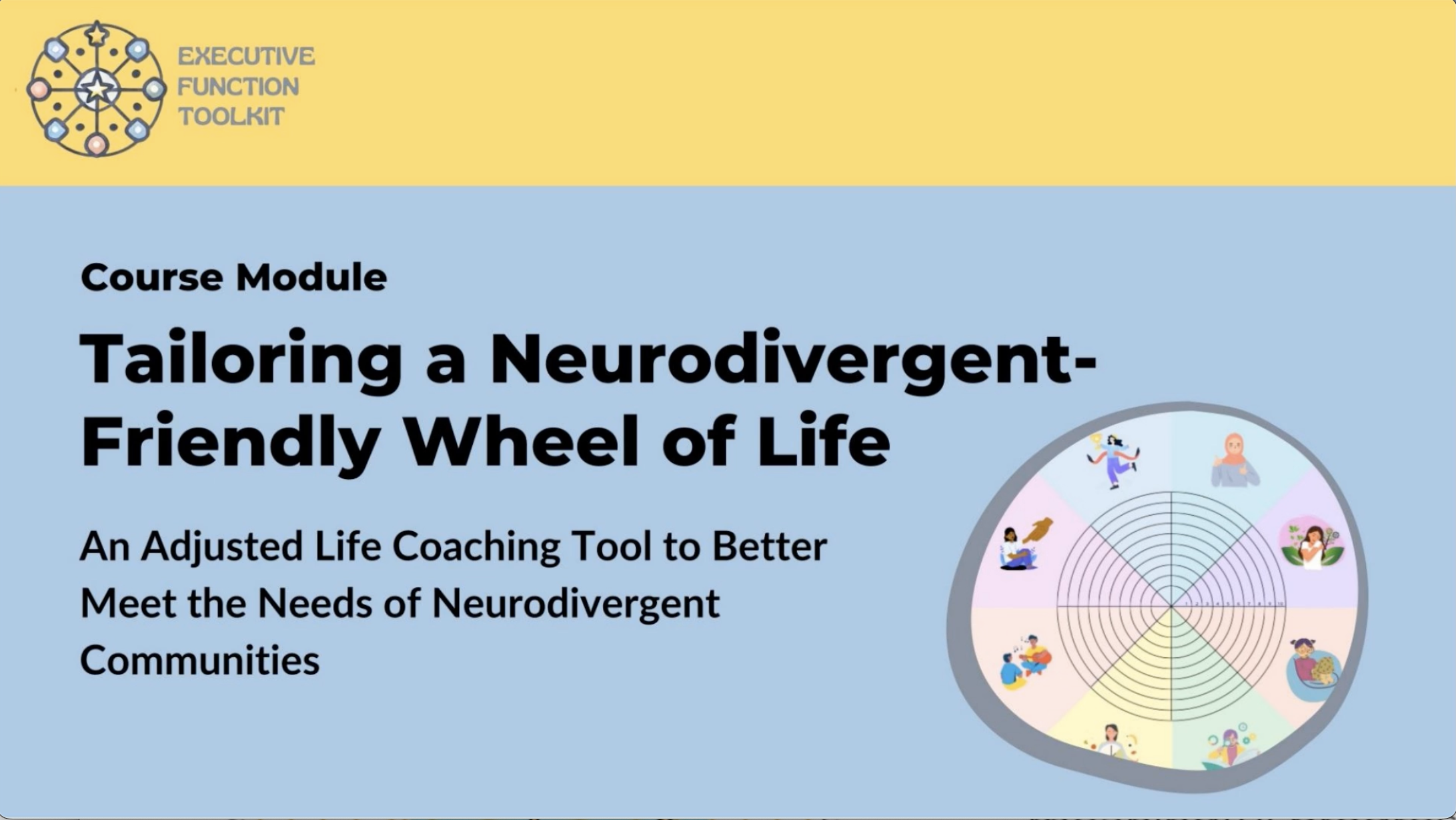
That’s why in this post, we’re rethinking the Wheel of Life—a highly regarded life coaching exercise—through a neurodivergent lens. We’ll explore its benefits, its limitations, and how we can reshape it into a tool that better supports neurodivergent individuals in creating the structure and stability needed to live more fulfilling lives. I’m also posting the course module here for you to watch!
What Is the Wheel of Life?
The Wheel of Life is a simple yet powerful visual tool used by individuals, life coaches, and others to reflect on satisfaction across major life areas (also commonly referred to as ‘life domains’)—think health, relationships, career, personal growth, and more.
Here’s how it works:
- You rate your satisfaction in each life area on a scale from 1 to 10.
- You mark those ratings on a wheel diagram.
- You use the results to identify areas for improvement, set goals, and track your progress over time.
It’s fundamentally a goal-setting tool, but it also reinforces important executive function skills like prioritization, planning, and task initiation.
Why It Falls Short for Neurodivergent Individuals
Here’s the problem: the Wheel of Life, as it’s traditionally used, assumes that certain foundational needs are already being met. It focuses on high-level goals—like improving a career or deepening a relationship—without acknowledging that many people are still struggling with basic routines, self-regulation, or daily functioning. Remember how in earlier posts I’ve mentioned that neurotypical self-improvement and planning tools, like planners, already assume that people are organized? Well, the neurotypical approach to the wheel of life is no different.
For neurodivergent individuals, particularly those with ADHD, autism, or learning disabilities, this fundamental assumption can feel alienating and even defeating.
That’s because:
- Executive dysfunction makes it hard to prioritize or even start goals.
- Sensory needs and emotional regulation are often ignored in traditional coaching frameworks.
- Social and self-identity struggles are oversimplified or overlooked altogether.
It can be discouraging to even begin thinking about overwhelmingly broad life areas, which aggravates executive function challenges in areas like task initiation and working memory.
Understanding Human Needs Through Maslow’s Lens
To understand this mismatch, it helps to revisit Maslow’s Hierarchy of Needs—a framework that organizes human needs into a five-level pyramid:
- Physiological needs (food, sleep, shelter)
- Safety needs (stability, routines, emotional and physical safety)
- Belonging and love (relationships, social support)
- Esteem (confidence, self-worth)
- Self-actualization (growth, goals, purpose)
Most traditional Wheel of Life categories center on levels 3–5—assuming levels 1 and 2 are already in place. But for many neurodivergent people, those foundational needs are still unstable.
We need a Wheel of Life that meets people where they are—not where we assume they should be.
A Neurodivergent-Friendly Approach to the Wheel of Life
Let’s reimagine the Wheel of Life by focusing on life areas that reflect the real, day-to-day challenges neurodivergent people face—things like executive function struggles, sensory needs, and the impact of stigmatized identities.
Here are 8 adapted life domains we recommend:
1. Executive Functioning & Daily Living
Build routines, reduce overwhelm, and support task initiation and organization.
2. Emotional Regulation & Stress Management
Manage intense emotions and reduce overwhelm through mindfulness and de-escalation strategies.
3. Self-Identity & Self-Compassion
Reframe negative self-beliefs, recognize strengths, and rebuild confidence and self-understanding.
4. Sensory Well-Being & Environmental Comfort
Create sensory-friendly spaces and reduce environmental triggers that impact focus and well-being.
5. Creative Expression & Passion Projects
Support joy, self-expression, and purpose through hobbies and intrinsically motivating activities.
6. Health & Wellness from a Neurodivergent Perspective
Focus on realistic improvements to sleep, nutrition, and movement—without shame or rigid expectations.
7. Communication & Social Relationships
Strengthen interpersonal skills while honoring communication differences and boundaries.
8. Advocacy & Navigating Systems
Learn to self-advocate, seek accommodations, and manage complex systems like healthcare or education.
Making It Work: Questions to Reflect On
When using a neurodivergent-friendly Wheel of Life, reflection and customization are key.
Ask yourself (or your client):
- Which life areas are most important right now?
- Which are most in need of support?
- What skills or supports are missing that could help move things forward?
- How does shame, burnout, or executive dysfunction get in the way of goal-setting?
You can also apply SMART goals—specific, measurable, achievable, realistic, and time-bound—to the life domains that feel most meaningful to you.
Try The Neurodivergent Wheel of Life Yourself
Want to give this version of the Wheel a try?
✅ Download our printable Neurodivergent Wheel of Life Worksheet
✅ Reflect on 8 life areas that feel most relevant to you
✅ Rate your satisfaction from 1–10
✅ Use your results to spark curiosity—not shame—and gently explore your next steps
Final Thoughts
Neurodivergent people have the same core needs as everyone else—but the paths we take to meet them can be very different.
By adjusting tools like the Wheel of Life to reflect real experiences—executive dysfunction, sensory sensitivity, and identity challenges—we unlock more honest self-reflection and more effective goal-setting.
And that’s what ThriveMind is all about: supporting growth that starts from where you really are—not where someone else thinks you should be. Follow the Kickstarter now to learn more!
You deserve support that fits.
For more, please check out the executive function blog! Thanks for reading, watching, and supporting!
References:
Boogaard, Kat. “How to write SMART goals.” Atlassian. https://www.atlassian.com/blog/productivity/how-to-write-smart-goals.
Cherry, Kendra. “Maslow’s Hierarchy of Needs.” VerywellMind. https://www.verywellmind.com/what-is-maslows-hierarchy-of-needs-4136760.
Sutton, Jeremy. “The Wheel of Life: How to Apply It in Coaching.” PositivePsychology.com. https://positivepsychology.com/wheel-of-life-coaching/.
Subscribe
Enter your email below to receive updates.
Leave a Reply