
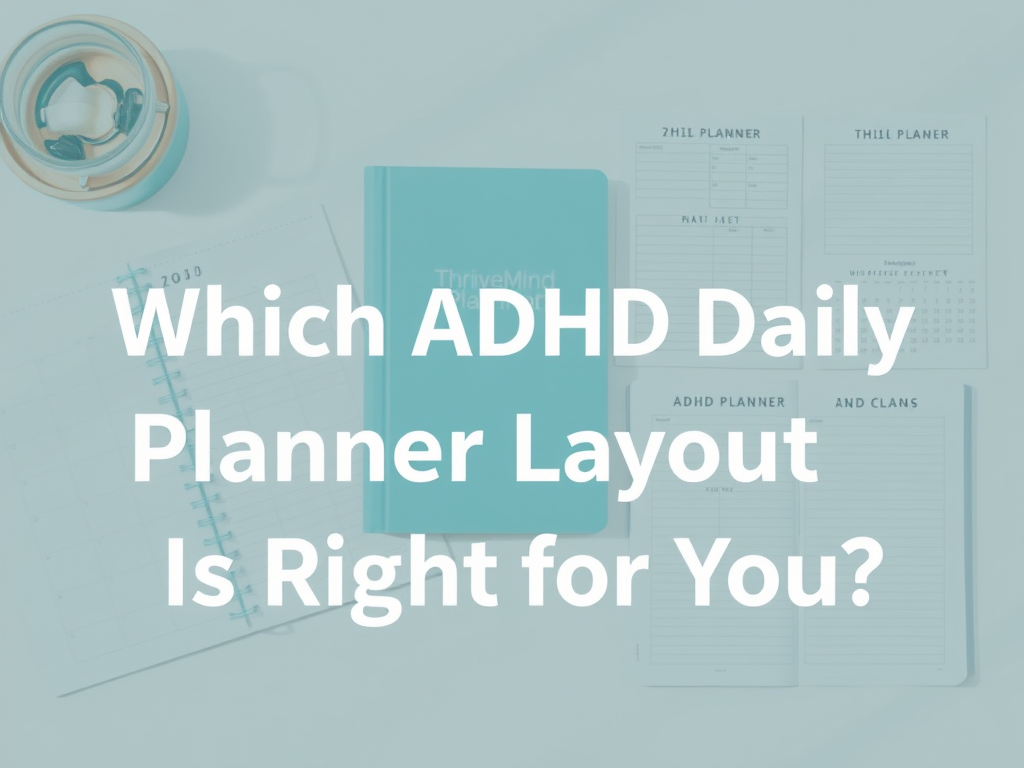
Finding the right ADHD daily planner can feel overwhelming—especially when most planners weren’t designed with neurodivergent brains in mind. If you’ve tried traditional planners only to abandon them weeks (or days) later, you’re not alone.
That’s exactly why I created the ThriveMind Planner—a flexible, neurodivergent-friendly system with multiple layout options built around different executive function needs. Whether you struggle with task initiation, emotional regulation, or sticking to a routine, there’s a layout that’s meant to work with your brain instead of against it.
In this guide, you’ll get a side-by-side comparison of all the current ADHD daily planner layouts (A, B, C, and E) to help you choose the one that fits your executive functioning style best. By the end, you’ll know which layout supports your unique rhythms—and be able to start using it right away.
Why Planner Layouts Matter for Autism, ADHD and Executive Dysfunction
For adults with ADHD, autism, or executive dysfunction, planning isn’t just about writing tasks down. It’s about managing overwhelm, remembering what matters, adjusting on the fly, and staying emotionally regulated throughout the day.
The layout of your daily planner plays a huge role in whether it becomes a helpful support—or another abandoned notebook.
Here’s why layout matters:
- It gives structure without rigidity
- It supports time awareness and memory
- It helps bypass task paralysis by simplifying the starting point
- It offers emotional scaffolding to reduce internal resistance
Each free ThriveMind Neurodivergent Planner layout covered below is designed with different executive function pain points in mind. Some are more structured, others more fluid. Some offer space to reflect, while others are built for quick action.
The goal? To help you find a planner system that feels like relief—not another demand.
Meet the Daily Planner Layouts: A Side-by-Side Overview
Before diving into each layout individually, let’s take a quick look at what sets them apart. Each ThriveMind ADHD daily planner layout was created to target a different combination of executive function challenges—like task initiation, planning, working memory, or emotional regulation.
Here’s a side-by-side comparison to help you get oriented:
| Layout | Best For | Key Features | Executive Function Focus |
| A | Clearing clutter & starting strong | Emotional check-in + task breakdown | Task initiation, working memory |
| B | Staying flexible & responsive | Real-time adjustment and re-prioritization | Cognitive flexibility, time awareness |
| C | Reflection & closure | Daily review, mood tracking + follow-through | Self-monitoring, emotional regulation |
| E | Balancing structure and spontaneity | Hybrid of structure and open space | Planning, emotional regulation, sustained focus |
These layouts aren’t ranked—they’re tools. What works best depends on how your executive functioning strengths and challenges show up day to day. Some people rotate layouts weekly. Others stick with one for months. You might even blend them in a custom hybrid!
Coming up next: a deep dive into each layout—complete with examples, use cases, and tips to make it your own.
Layout A: Clear the Clutter and Start Strong
Best For:
If you often feel overwhelmed before you even begin—or freeze because your mind is cluttered with too many thoughts—Layout A is your go-to. It’s designed to help you emotionally check in, break down your day into manageable pieces, and just start.
Key Features:
- Emotional check-in box: helps surface what you’re feeling before you dive into tasks
- Visual task breakdown: separates “top 3 tasks” from smaller or lower-priority ones
- Gentle momentum-builder: supports task initiation without pressure
Executive Function Skills Supported:
- Task Initiation: Helps you bypass inertia by identifying your first step
- Working Memory: Keeps key tasks visible and emotionally anchored
- Self-awareness: Encourages emotional processing so feelings don’t block action
When to Use It:
- On days when you feel foggy, unfocused, or emotionally heavy
- When you’re stuck in a cycle of avoidance, scrolling, or mental noise
- When you want to start strong without overcommitting
Pro Tip:
Use a highlighter or sticker to mark your “first win” of the day. Visual proof of progress helps reinforce follow-through when your brain wants to check out.
Try Layout A if: Starting is the hardest part.
Explore Layout A Here
Layout B: Stay Flexible and Responsive
Best For:
If your day tends to shift unpredictably—or if you thrive when you can adjust your priorities in real-time—Layout B offers a responsive structure. It’s especially helpful for ADHD brains that need to adapt quickly without losing track of what matters.
Key Features:
- Task slots with time anchoring (but no rigid schedule)
- Room to update or reprioritize tasks as your energy shifts
- Space for noting interruptions or obstacles without shame
Executive Function Skills Supported:
- Cognitive Flexibility: Supports dynamic re-prioritization without decision fatigue
- Time Awareness: Light structure helps you track time without overwhelm
- Planning & Adjustment: Balances intention with adaptability
When to Use It:
- When you have a mix of fixed and flexible commitments
- On days when you expect distractions or shifting energy levels
- If you’re prone to perfectionism and want to make space for “good enough”
Pro Tip:
At midday, pause and revisit your list. Update your top priorities based on how things have gone—and cross off anything that no longer matters.
Try Layout B if: You need structure that bends with your day.
Layout C: Reflect and Reconnect
Best For:
If you struggle with follow-through, emotional processing, or ending your day with a sense of closure, Layout C is your reflection-based reset. It’s designed to gently help you notice what worked, what didn’t, and how you felt—without judgment.
Key Features:
- End-of-day reflection prompts: review what got done and how you felt about it
- Emotional regulation cues: track mood patterns and overwhelm triggers
- Success tracking: celebrate wins (even tiny ones) and recognize effort
Executive Function Skills Supported:
- Self-Monitoring: Builds awareness of behavior and patterns
- Emotional Regulation: Supports decompression and reduces end-of-day spirals
- Working Memory: Reinforces what worked (and what didn’t) for future planning
When to Use It:
- On days that felt chaotic, emotional, or off track
- If you’re building new routines and want to reflect on progress
- When you need closure before you can relax or sleep
Pro Tip:
Use emojis or color-coding to represent your emotional tone across the week. It turns your planner into a mini mood tracker—and helps spot burnout patterns early.
Try Layout C if: You need a gentle end to messy days.
Explore Layout C Here
Layout E: Structure + Spontaneity in Balance
Best For:
If you crave just enough structure to stay on track—but not so much that you feel boxed in—Layout E offers a flexible hybrid approach. It’s ideal for days when your executive function needs guardrails, but your creativity needs room to breathe.
Key Features:
- A flexible structure with open-ended sections
- Prioritization blocks without rigid scheduling
- Balanced layout for focus, tracking, and flow
Executive Function Skills Supported:
- Planning: Guides the day without micromanaging it
- Emotional Regulation: Prevents overwhelm with space for pauses
- Focus: Helps you anchor attention without losing flexibility
When to Use It:
- On days when you need to be productive, but not over-planned
- If you tend to rebel against too much structure
- When your emotional state varies hour by hour
Pro Tip:
Pair this layout with a Pomodoro timer and a gentle playlist. The visual structure keeps you grounded while the open space lets you adapt as needed.
Try Layout E if: You thrive with gentle scaffolding—not strict rules.
Explore Layout E Here
How to Choose the Right ADHD Planner Layout for Your Brain
There’s no one-size-fits-all planner—especially if you’re neurodivergent. That’s why the ThriveMind Planner includes multiple layouts designed to support different executive function challenges. You might find one that works beautifully day after day—or you might rotate layouts based on your energy, schedule, or mood.
Here’s a quick guide to help you decide where to start:
If you struggle with…
| Executive Function Challenge | Try This Layout | Why It Helps |
| Starting tasks or feeling overwhelmed | Layout A | Emotional check-in + visual breakdown gives you an easy entry |
| Your day changing constantly or unpredictably | Layout B | Flexible structure lets you re-prioritize without pressure |
| Finishing the day feeling scattered or guilty | Layout C | Reflection prompts help you close loops and build awareness |
| Needing structure without rigidity | Layout E | Balanced layout gives you guidance and freedom |
Still not sure?
Ask yourself:
- Do I tend to freeze before I start? → Start with Layout A
- Do I get frustrated when my plans shift? → Try Layout B
- Do I forget what I’ve done or feel like I did “nothing”? → Use Layout C
- Do I resist traditional planning altogether? → Go with Layout E
You can also try rotating through layouts each week or printing multiple layouts to use as needed. Think of it like trying on different shoes for different terrains—each layout supports a different kind of day.
You Deserve a Planner That Works With Your Brain
Executive dysfunction doesn’t mean you’re incapable—it means you need tools that actually support how your brain works. That’s the heart of the ThriveMind Planner: layouts that help you focus, regulate, reflect, and plan in ways that feel doable, not defeating.
Whether you’re drawn to the structure of Layout A, the flexibility of Layout B, the reflection of Layout C, or the balanced design of Layout E, the most important step is this: start small and stay curious. You don’t have to get it perfect—you just have to find what feels right for you.
Planners aren’t magic fixes. But the right layout can give you scaffolding—something to lean on when executive function gets shaky.
Ready to Try It?
Download the Free ADHD Daily Planner Layout Sampler Pack
Try all the layouts and see which ones feel most supportive.
Shop the ThriveMind Planner (Coming Soon)
Grab the full planner or mix-and-match layout pages.
Join the Executive Function Toolkit Newsletter
Get weekly tips, tools, and gentle reminders to support your executive functioning.
Progress doesn’t come from pushing harder—it comes from having the right supports in place. You’re not behind. You’re just finding the tools that help you move forward.