Time management strategies and supports help you build structure, plan realistically, and follow through on daily tasks. For neurodivergent adults, especially those with ADHD, autism, or learning differences, these tools and strategies provide external systems that reduce stress and make time feel more manageable.
Time management strategies & supports address common executive function challenges, such as:
Related challenges: Time Blindness | Procrastination
Time management is the executive function skill most directly linked to time blindness. Task initiation is the executive function skill most directly tied to procrastination. Here are time management support tools and strategies that can help:
Ask yourself:
Tip: Start small with one or two tools. Research on building new habits shows that we’re more likely to succeed when we only change a little bit at a time. Build gradually to avoid overwhelm and up your chances of success.
Set two alarms: one to start a task, one as a gentle warning to wrap up.
Use time blocking: Assign fixed blocks for focused work, admin tasks, and breaks.
Pair a planner with a visual timer for both big-picture and moment-to-moment time awareness.
Related: Planning & Prioritization | Task Initiation
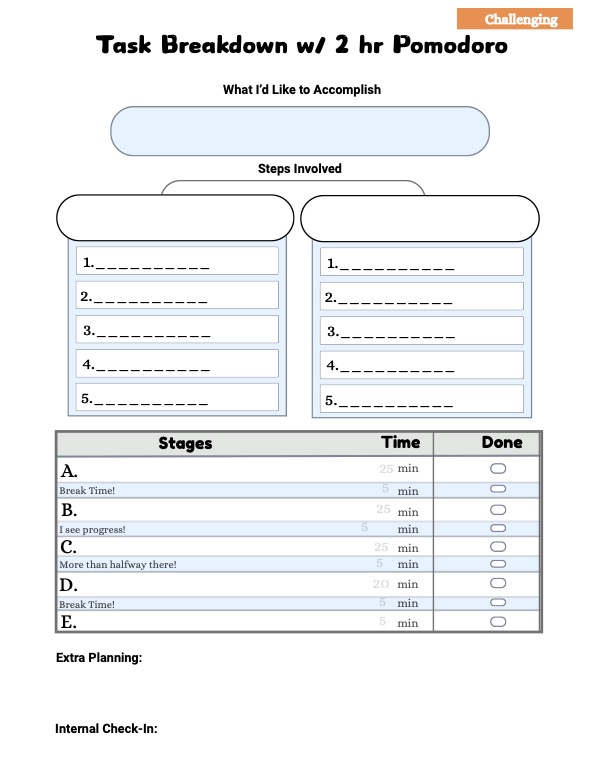
✅ Try our 1HR, 2HR and 3HR Pomodoro Technique and Task Breakdown Worksheets
✅ Explore related skills:
Time Management | Planning & Prioritization
✅ Sign up for our newsletter for more tools
References:
Gardner B, Lally P, Wardle J. Making health habitual: the psychology of ‘habit-formation’ and general practice. Br J Gen Pract. 2012 Dec;62(605):664-6. doi: 10.3399/bjgp12X659466. PMID: 23211256; PMCID: PMC3505409. https://pmc.ncbi.nlm.nih.gov/articles/PMC3505409/.