
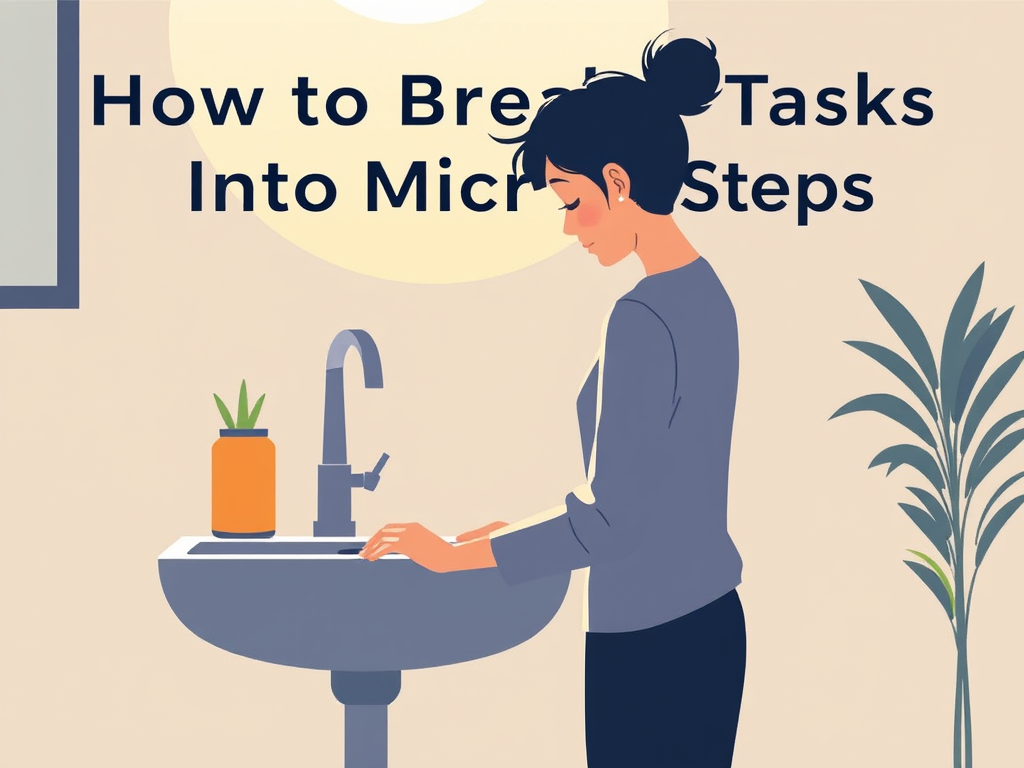
When you’re facing a big task — or even a small one that feels big — it can be hard to know where to begin. Especially for those of us with ADHD, autism, or executive function challenges, a task that seems simple on paper can feel overwhelming in practice.
That’s where micro-steps come in. Breaking a task into micro-steps transforms something daunting into something doable — one tiny action at a time.
- In this post, you’ll learn:
- What micro-steps are
- Why they work (especially for neurodivergent brains)
- How to break any task down into micro-steps
- Examples to help you get started
What Are Micro-Steps?
A micro-step is the smallest, simplest action you can take to move a task forward. It’s so quick and easy that it bypasses resistance, helping you break free from the mental weight of starting.
Instead of focusing on the entire task—which can feel overwhelming—micro-steps shift your attention to just the next tiny move. This approach works because it reduces the pressure on your brain’s executive function, making it easier to gain momentum without overthinking.
Examples of Micro-Steps
- Opening the document you need to work on.
- Turning on the kitchen sink before doing the dishes.
- Writing the first word—or even the first letter—of an email.
- Grabbing your planner and a pen.
- Clicking “compose” on a new message.
- Setting a timer for two minutes of tidying instead of tackling an entire room.
- Bookmarking the first article for research instead of finishing the whole outline.
Pro Tip:
If a task feels impossible, shrink it until it feels laughably easy. The goal isn’t to finish—it’s to start. Once you begin, momentum and focus often follow.
Why Micro-Steps Work
Micro-steps are powerful because they break through the mental friction that makes starting a task feel impossible. For many people—especially those with executive function challenges—getting started is the hardest part. Micro-steps work by shrinking that “starting point” into something so small and simple that your brain can’t talk you out of it.
How They Help Overcome Executive Function Barriers
- Task initiation difficulties – Lowering the activation energy
Starting a task often feels like pushing a heavy boulder uphill. Micro-steps make that first push so small that it feels effortless.
Example: Instead of “write the report,” you simply “open the document.” Once it’s open, writing a single sentence feels easier. - Overwhelm and avoidance – Shrinking big tasks into approachable pieces
Large, undefined tasks can trigger avoidance because they feel endless. Micro-steps reduce the scope to one clear, bite-sized move, which eliminates the sense of “too much at once.”
Example: Rather than “clean the whole kitchen,” you start by “putting one plate in the dishwasher.” One plate leads to the next. - Perfectionism and overthinking – Focusing on action, not outcome
When the pressure to do something “perfectly” is removed, it’s easier to act. Micro-steps shift the focus from “finishing flawlessly” to “just begin.”
Example: Writing a single word in a draft breaks the mental barrier of the “perfect first paragraph.”
The Momentum Effect
Each tiny step builds on the one before it. By moving into action—even in the smallest way—you create a sense of progress, which sparks motivation. This reverses the common myth that you need motivation to act. In reality:
Action creates motivation, not the other way around.
Once you’ve started, your brain is more willing to keep going because it no longer sees the task as a massive obstacle.
Key Takeaway:
Micro-steps don’t just make tasks easier—they rewire how you approach them, helping you move from stuck and overwhelmed to steady, sustainable progress.
How to Break a Task Into Micro-Steps
Breaking a task into micro-steps is about taking something that feels overwhelming and reducing it to the smallest, most approachable actions. This process removes decision-making friction and helps you start without overthinking.
1. Name the task that’s giving you trouble
Write it down. Be clear and specific so your brain knows exactly what you’re tackling.
- Example: Instead of “clean the kitchen,” write: “Wash the dishes.”
Why it helps: Naming the task reduces mental clutter and turns an abstract goal into something concrete.
2. Break it into 2–3 small steps
Think of the broad, simple actions that need to happen first.
Example:
- Turn on the sink
- Gather dirty dishes
- Put on gloves
Why it helps: Chunking a task into a few basic parts gives you a clear starting map instead of one big, undefined job.
3. Break each small step down further
Now, zoom in on the tiniest actions inside each step. These are your true micro-steps.
Example:
- “Turn on the sink” → Walk to the sink → Reach for the faucet → Turn the handle
- “Gather dishes” → Pick up cup → Pick up plate → Pick up fork
Why it helps: Each micro-step is so easy it feels almost impossible to fail. This is what lowers the “activation energy” and gets you moving.
4. Start with the tiniest action
Choose one single micro-step and do it. That’s it. Once you complete it, you’ve already succeeded—and often, momentum kicks in naturally.
Example: Just walk to the sink. If that’s all you do, it still counts.
Tip: If it still feels too big, break it down further until it feels almost laughably small. (“Walk to the sink” can become “stand up” or “take one step forward.”)
Why This Works
By breaking tasks down until there’s no resistance left, you remove the biggest barrier: starting. Once you’ve done the first micro-step, your brain shifts from avoidance to action, and the rest of the task often becomes easier.
Example: Micro-Stepping a Common Task
Task: “Write a report”
- Open the file where you’ll write
- Type the report title
- Write the first sentence
- Write a second sentence
You don’t need to do it all at once. Micro-steps give you permission to move slowly and steadily — and build confidence with each small win.
Final Thoughts: One Micro-Step at a Time
When you feel stuck, remember: you don’t have to climb the whole mountain today. Just take the next tiny step. And then the next. That’s how big things get done. Your next tiny step could be downloading the task breakdown sheet (a free downloadable executive function worksheet) below and filling it out!
If you’re using the ThriveMind Planner or another tool, try listing your micro-steps in the Task Blastoff section to stay focused and reduce overwhelm.